


Printing Lamination Film for Heavy Ink Coverage and Difficult Substrates
In lamination, the easy jobs are the ones nobody writes about: a light ink film on coated paper, bonded to a smooth filmic surface, under even pressure. The jobs that consume a converter's week are different. A four-colour solid with 300% ink coverage. A metallised advertising sheet. A 1 mm brushed stainless plate that pulls heat out of the bond line faster than the adhesive can wet it. A PVC sheet carrying plasticiser that migrates into anything it touches.
These are not adhesive problems in the ordinary sense. They are surface problems - the substrate refuses to be wet out, or removes the heat needed to wet it, or changes dimension underneath the bond after it has formed. A general-purpose laminating film fails on them for reasons that are predictable once the mechanism is understood.
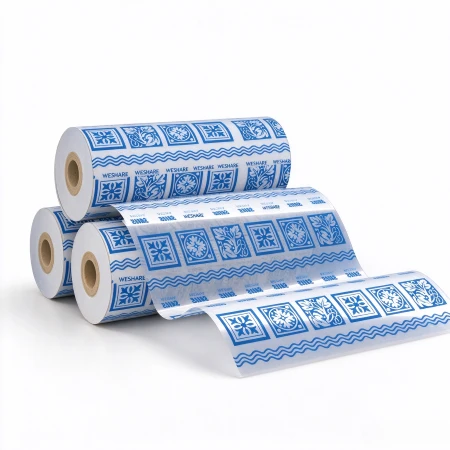
This film is developed for that class of work. It is a PET-core hot melt adhesive film with strong adhesion to heavy ink print and to the substrates that ordinary lamination film struggles with - paper, advertising paper, PET, PP, PVC, aluminium film, aluminium plate and stainless steel plate - supplied to custom width and thickness.
Specifications
| Property | Value |
|---|---|
| Structure | Hot melt adhesive on a PET carrier |
| Product form | Roll; size and thickness customised to customer requirement |
| Adhesion target | Heavy ink print and low-absorption substrates |
| Claimed substrate range | Paper, advertising paper, PET, PP, PVC, aluminium film, aluminium plate, stainless steel plate |
| Optical | High transparency |
| Mechanical | High toughness, tear resistant |
| Printability | Printable without damaging the surface |
| Bonding method | Heat and pressure lamination |
| Solvent content | None |

Why heavy ink is the hardest surface in lamination
An ink film is not a decoration sitting passively on paper. It is a chemically complex layer, several microns thick, that changes every property the adhesive depends on. Five mechanisms explain almost every heavy-ink bonding failure.
1. Thickness creates a rough, compressible surface
At 300–400% total ink coverage the ink film can be several microns thick, with a topography produced by dot gain, trapping and the sequence of units. The adhesive is no longer bonding to paper - it is bonding to an uneven polymer layer that compresses under nip pressure. Where the pressure is highest the bond line is starved; where it is lowest no contact is made at all. The result is a bond that is strong in patches and weak between them, which typically fails as a mottled or patchy delamination rather than a clean peel.
2. Surface energy drops
Inks are formulated with waxes, slip agents and silicone-based additives to control rub resistance, gloss and set-off. Those additives migrate to the ink surface - that is how they work - and they lower the surface energy precisely where the adhesive needs to wet it. A surface that measures well on paper can measure poorly on the ink printed over it. This is the single most common reason a film that bonds perfectly on an unprinted area fails on the printed area of the same sheet.
3. UV inks are crosslinked and inert
UV-cured inks form a highly crosslinked network with little chemical reactivity left at the surface. There is no residual solvent to soften the interface, no unreacted monomer to co-dissolve with the adhesive, and no porosity to key into. Bonding to fully cured UV ink depends almost entirely on mechanical wetting of the surface texture - which is why it needs more heat and more pressure than a conventional ink, and why under-cured or over-cured UV ink both cause problems.
4. Anti-setoff powder occupies the interface
Sheetfed offset presses spray starch or coated powder to stop wet sheets sticking. The powder lands on the printed surface and sits exactly where the adhesive must make contact. A light dusting can be displaced by pressure; a heavy application forms a continuous release layer. Adhesion failures that appear only on jobs from a particular press, or only on the last sheets of a stack, are usually powder, not film.
Dried ink is not necessarily cured ink
Conventional offset inks dry largely by absorption and oxidation. If the stack is cut and laminated before oxidation is complete, residual solvent and unreacted components remain in the ink film. Under a laminated surface that solvent has nowhere to go: it plasticises the bond line from beneath, and the failure appears days later as blistering or a slow edge lift. The film gets blamed; the ink was never ready.
What follows for specification. A film intended for heavy ink must do three things: reach a high enough activation temperature to soften the ink surface and wet it, stay fluid long enough to flow into a rough compressible layer, and remain flexible after cooling so that the ink's own movement does not peel it off. That combination is a formulation problem, and it is the reason a heavy-ink film is not simply a general film run hotter.
Why metal is the second hardest substrate
The claimed substrate list includes aluminium film, aluminium plate and stainless steel plate. Each brings a different obstacle, and the plate substrates bring the most underrated one in lamination: heat loss.
The heat-sink effect
A hot melt bond forms because the adhesive reaches a temperature at which it flows and wets. On paper, the substrate is an insulator: the heat delivered at the nip stays at the interface. On a 1 mm aluminium plate, the substrate is a heat sink. Heat flows out of the bond line into the metal almost as fast as the nip delivers it, so the interface temperature is far below the surface temperature of the heated tool, and the adhesive may never reach a flowing state at all.
This is why metal bonding fails in a way that looks inexplicable: the film is correct, the temperature setting is correct, the pressure is adequate, and the bond is still weak. The remedy is process-side - higher tool temperature, longer dwell, slower line speed, or pre-heating the metal - and it must be established by trial on the actual gauge of plate, because a 0.5 mm sheet and a 2 mm plate behave completely differently.
Zero absorption, so no mechanical key
Paper and board accept a degree of penetration that contributes to bond strength. Metal accepts nothing. The entire bond depends on wetting and on the adhesive's ability to conform to surface texture - which on brushed or rolled plate is directional and sometimes deliberately coarse.
Differential expansion
Aluminium expands roughly twice as much as steel for the same temperature rise, and both expand far more than paper. A bond between a metal plate and a paper or film facing is therefore loaded in shear continuously as the assembly moves through temperature cycles. A rigid adhesive concentrates that movement at the edges; a flexible one distributes it. This is the reason toughness matters as much as peel strength on metal work.
Edges, burrs and contamination
Sheared plate carries a burr on one face. A bond line running over a burr has a stress concentration and a thickness discontinuity at the same point. Laser-cut edges carry oxide; stamped edges carry oil. Both are release layers in practice, and neither is visible after lamination.

Construction and the toughness requirement
The film is a hot melt adhesive carried on a PET core. The PET core does the same structural job as on any hot melt film - it holds the bond line uniform, prevents adhesive strike-through into the printed or facing surface, carries the web under tension and keeps the finished assembly dimensionally stable. What is different here is the balance between adhesion and toughness, and the source material states it explicitly: the film is tear resistant and does not peel away easily.
Toughness matters in three places on this product's applications:
Thin print substrates. Heavy ink coverage is often applied to thin coated paper, advertising paper or film. Those substrates flex, and a brittle bond will crack before the substrate does. Tear resistance in the film also protects the substrate at the cut edge, where a sharp tool and a stiff film combine to start a tear.
Metal edges. A bond running over a plate edge is loaded in peel at a stress concentration. A tough adhesive film deforms and holds; a brittle one propagates a crack from the edge inward.
Handling and conversion. Printed sheets are handled repeatedly between lamination and finishing - guillotining, die-cutting, folding, packing. A bond that survives the laminator but fails at the guillotine has not solved the customer's problem.
Printability: a film that can carry the graphic
The product is printable without damaging the surface finish. That property matters more than it first appears, and it opens a class of work that ordinary laminating film cannot do.
Where a printed film is useful:
Decorative lamination. The graphic is printed on the film, then the film is bonded to the substrate. The print sits under a clear protective layer instead of on top of the product, so it resists abrasion, cleaning and handling - the failure mode that destroys printed surfaces in service.
Register-laminated packaging. A printed pattern on the film, bonded to board or to a shaped part, gives a decorative effect that cannot be achieved by printing directly onto a complex or non-printable substrate.
Short-run and custom graphics. Printing the film rather than the substrate removes the substrate from the print qualification process, which shortens the route from artwork to finished part.
Functional marking. Product identification, orientation marks and safety graphics applied as part of the bond rather than as a separate label operation.

Substrate compatibility: what to watch on each
| Substrate | What makes it work | What to watch |
|---|---|---|
| Paper and board | Absorbs nothing much, but thermally insulating - heat stays at the interface | Moisture content: damp board produces steam under the film and blisters |
| Advertising paper / coated stock | Smooth, high hold-out surface bonds well | Coating chemistry: some cast-coated grades are formulated as release surfaces |
| PET film | Chemically compatible with the PET carrier; good wetting | Surface energy of the specific grade; untreated PET is marginal |
| PP film | Low surface energy but bonds with adequate heat | Thin gauge and high shrinkage: the film must not fight the PP's relaxation |
| PVC sheet | Bonds readily at moderate temperature | Plasticiser migration into the bond line over time; a plasticiser-resistant adhesive chemistry is essential |
| Aluminium film (foil) | Thin, conforms, conducts heat away quickly | Pinholes and rolling oil on the foil surface act as release layers |
| Aluminium plate | Achievable with pre-heat and longer dwell | Heat sink effect, oxidation, differential expansion against the facing |
| Stainless steel plate | Achievable with the highest dwell in the range | Lowest thermal conductivity of the metals but highest stiffness - differential expansion loads the bond in shear at the edges |
On PVC specifically. Plasticised PVC is the substrate most likely to produce a delayed failure that is blamed on the film. Plasticiser migrates continuously; if it reaches the bond line it softens the adhesive from inside. A bond that tests well at 24 hours can be substantially weaker at 30 days. PVC work should always be qualified with aged testing, and should never be quoted on the basis of an initial peel figure.
Application
Advertising and display print. Large-format sheets, display board and printed panel work where ink coverage is high, the visible surface must stay flat and the bond must survive handling and transport. The combination of heavy ink and a large area is where a general film shows its limits first.
Packaging and premium print finishing. Rigid and folding box work, label stock and promotional print where the printed surface is the product. Here the value of the film is that it bonds without strike-through, so the print stays sharp.
Metal signage and plates. Aluminium and stainless plates carrying a printed or filmic facing - signage, nameplates, instrument panels, architectural trim. The heat-sink effect and differential expansion are the two engineering constraints, and both are addressed by pre-heat and a flexible bond line rather than by a stronger adhesive.
Decorative and functional film lamination. Printed film bonded to board, panel or shaped parts, where the graphic must sit beneath a protective layer rather than on the surface.
Mixed-material assemblies. Where two substrates with nothing in common - paper and aluminium, PVC and board, print and steel - must be joined without mechanical fasteners.
Troubleshooting: symptom, cause, correction
| Symptom | Most likely cause | Correction |
|---|---|---|
| Bond strong on unprinted margin, weak on the printed area | Ink surface energy too low, or ink film too rough for the bond line | Raise activation temperature; increase pressure; specify a heavier adhesive layer |
| Patchy or mottled delamination across a heavy solid | Uneven ink topography starving the bond line at high spots | Increase pressure and dwell; consider a thicker adhesive layer to fill the topography |
| Failure only on sheets from one press or one part of a stack | Anti-setoff powder, or ink not fully oxidised | Reduce powder; allow full ink cure before lamination; test a settled sheet |
| Blistering within 24–72 hours | Trapped solvent or moisture driven off under the film | Confirm ink dryness and substrate moisture; extend conditioning before lamination |
| Weak bond on aluminium or stainless plate that improves near the edge | Heat-sink effect - interface never reached temperature | Pre-heat the plate; raise tool temperature; slow the line |
| Edge lift on metal work after a few days | Differential expansion loading a rigid bond line | Reduce cooling stress by holding pressure longer; use a more compliant build |
| Bond fails on PVC after weeks, not days | Plasticiser migration into the adhesive | Specify a plasticiser-resistant chemistry; qualify by aged test |
| Tear initiates at the cut edge of thin print | Stiff film and a dull cutting tool | Sharper tooling; film with higher tear resistance |
| Adhesive transfer to the laminator roller | Slit edge quality, or activation temperature too high for the dwell | Check edge quality; reduce temperature and extend dwell |
How this film differs from the general-purpose double-sided film

| Requirement | Double-sided hot melt film | This printing lamination film |
|---|---|---|
| Smooth, matched surfaces with light ink | Adequate | Also adequate, but over-specified |
| Heavy ink coverage, 300%+ solids | Prone to patchy bonding | Developed for it |
| Aluminium plate, stainless plate | Not the intended range | Intended range, with process adjustment |
| PP, PVC, metallised film | Possible with trial | Intended range |
| Gift box wrap, apparel bonding | Intended range | Not the intended application |
| Printed graphic on the film itself | Not a stated capability | Stated capability |
Incoming inspection
Thickness across the web width - a bond-line thickness that drifts changes the bond on heavy ink before it changes it anywhere else.
Adhesive coat weight per face, within stated tolerance.
Roll build, edge quality and width - a ragged edge transfers adhesive to the nip roller within a shift.
Peel on the customer's real substrate pair, before and after ageing - for ink work use a printed sample from the actual job; for PVC and metal, use an aged test.
Trial bond at production speed, inspecting for wet-out, read-through and edge lift.
Optical check on a bonded sample - clarity and absence of orange-peel texture.
Blocking resistance after storage at the expected warehouse temperature.
FAQ
What makes this film different from a standard laminating film?
Its adhesion is developed for surfaces that resist bonding: heavy ink laydowns, low-surface-energy plastics and metal plate. A standard film bonds to paper well and to those surfaces poorly, and the difference shows up as patchy delamination or edge lift rather than an obvious failure.
Can it bond to stainless steel plate?
Yes, within process limits, and the limiting factor is heat rather than adhesion. Steel plate conducts heat away from the bond line, so the interface temperature is lower than the tool temperature. Pre-heating and longer dwell are usually necessary, and the correct settings must be established on the actual plate gauge.
Will it bond over a heavy UV ink solid?
It will, with the right window: higher activation temperature, adequate pressure, and full ink cure before lamination. UV ink is crosslinked and low in surface energy, so it is the most demanding ink type. Trial it on the real job rather than on a test patch.
Is the film itself printable?
Yes, printable without damaging the surface. Whether printing is done in the supply chain or on the customer's press, and which ink systems are qualified, must be confirmed per project - a printability claim without a named process invites the wrong enquiry.
Does the film contain solvent or VOC? The adhesive is a hot melt system; bonding is by heat and pressure with no solvent to evaporate. Confirm the specific chemistry and its documentation for your market before making a compliance claim in writing.
Why does the bond fail at the edges of a metal panel? Differential expansion. The metal moves more than the facing, and a rigid bond line concentrates that movement into peel at the edge. A more compliant build, longer cooling under pressure, and correct pre-heat all address it.
Can it be used on PVC?
Yes, and PVC is the substrate most likely to produce a delayed failure. Plasticiser migrates into the bond line over time, so aged testing is mandatory before a PVC application is quoted.
What thickness should we specify?
Thickness follows the substrate and the joint: thin builds for smooth matched surfaces and fine print, heavier builds to fill ink topography or to bridge roughness on plate. The thickness range for this product is quoted per requirement - do not assume it matches another product in the range.
Hot Tags: printing lamination film, China printing lamination film manufacturers, suppliers, factory, Cold Lamination Film For Posters, Easy Post Window Sticker, Rough Matte Cold Laminating Film, Self adhesive Lamination Film, Twill Floor Graphics Film, Twill Floor Graphics Film No Skid